
Roof Replacement Articles by Roofing Contractors

The pervasiveness of American slating

June 11th, 2011

The pervasiveness of American slating references here, particularly in this century, is unquestionable. American architectural books and construction guides, which were well known in Canada, often contained advice to slaters or to roof replace contractors. The Canadian Architect and Builder in answer to inquiries concerning slate drew on American pocketbook authorities such as Kidder and Hodgson. That Hodgson was, in fact, a Canadian could suggest a greater exchange of technical experience between Canada and the United States than his co-authored publications out of Chicago might imply. American dominance of the architectural press in North America was, nevertheless, paramount and was reflected in journals like The Canadian Engineer that reprinted articles on slating from American periodicals such as Stone and reported American research on slate.  The United States quarries and their agents also produced pamphlets for their clients, Canadians included, explaining the kinds of slate and how slates were put on the roof. The National Slate Association, organized in 1922 by American slate producers, architects and contractors published a 1926 handbook, Slate Roofs, detailing information on types of slate, roof construction and slate application techniques. Definitions for standard, textural and graduated slate roofs worked out by the Association were the basis of roofing slate standards adopted by the American Society for Testing Materials (ASTM) and influenced slate specifications adopted by the as Canadian Bureau of Standards. as The 20th-century standards for roofing slate were building material classifications that did not encompass application practice.

Implications Causing Roofers to Enter Slate Business

June 10th, 2011

One of the implications of other roofers entering the slating business was that the importance of experience passed-down from one roof company to another was reduced while the technical direction of trade journals and building product suppliers, that is the slate quarries, was correspondingly enhanced. This evolution in the slating trade meant that Canadian slating practice, which started with British and some French influences, ended with almost exclusive dependence on the methodology of its American suppliers. At the outset of roofing slate production and use in Canada and the United States, both countries showed a strong and natural reliance on British know-how in slate extraction and application. Welsh quarry men initially operated the Quebec, Vermont, New York and Pennsylvania slate quarries. The architects and tradesmen of the 1860-80s period had direct experience of homeland work and these techniques were popularized both by example and the North American publication and distribution of British builders’ encyclopedias by Peter Nicholson, Joseph Gwilt, and J.C. Loudon.5 Canadian and American professional periodicals also printed extracts on slating from the National Builder and Planat’s Encyclope’die de’architecture etde la construction. By the late 1890s, however, American-generated advice on slating became increasingly evident in the Canadian Architect and Builder and was reinforced by the guides and leaflets produced by the American slate industry, the source of most slate used in Canada after 1900.

Laying Slate Roofs

June 9th, 2011

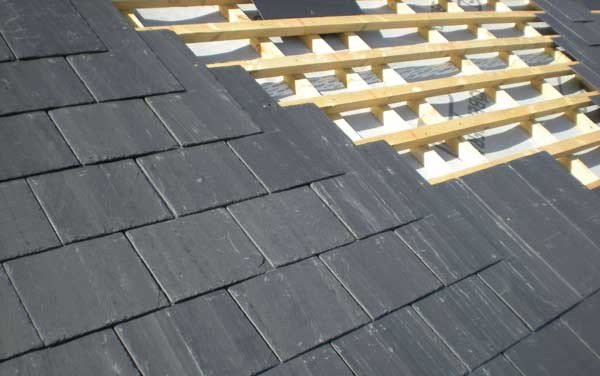
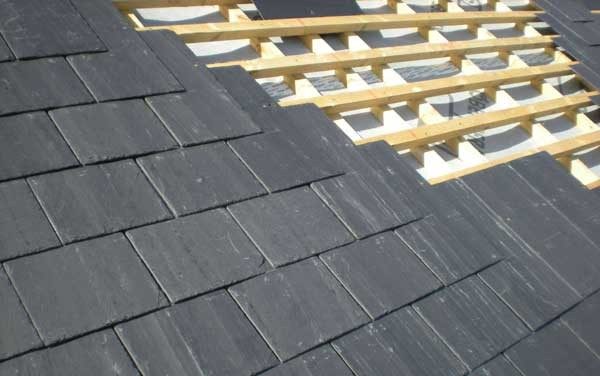
The business of slating consisted chiefly in covering the roofs of buildings with slate and all the variations in sizes, laps and fastenings that that could entail. Slate covering was also influenced to an extent by other roof elements, particularly the form, structure, under sheathing and flashing. For any given historical period in Canada the best documentation or most complete description of local slate work is furnished by the extant slate roof. The building historian cannot hope to examine enough roofs to put together a picture of Canadian practice in this way. What I have done, however, is look at the practitioner, the roof contractors, the historic influences on the slating trade and the advice dispensed in builders’ handbooks and the how-to columns of Canadian architectural journals. Against this background, by sampling building specifications and historic and contemporary photos, it is possible to identify the highlights of Canadian slate roofing practice from mid-19th century to the 1930s.

In 1918, an American periodical published an article entitled “Who does the Slate Roofing in your town?” The question revealed the traditionally close association between the slater and other mechanics in the roofing process. It also showed the blending of roofing trades which was well underway in the heyday of slate roofing in Canada. At mid-19th century, building specifications clearly distinguished between the tasks of the slater, plumber and iron worker on the roof. As the century wore on the functions of each trade were increasingly blurred.” Slater’s specifications sometimes included lead or cop- per work and galvanized iron work. “Roofing” specifications described the work of several trades and roofers ads, reflected this grouping of expertise. The result was that contracts were awarded to roofing companies that provided all roofing services. It was to take advantage of this situation that the magazine Metal Worker, Plumber and Steam Fitter, in 1918, posed the question “Who Does the Slate Roofing…?” Urging his mechanics to learn slating, the editor argued: Tin for valleys, gutters and flashings is needed for slate roofing, and nobody can furnish and place it more advantageously than the tin roofer. This secures favor for his bid for the slate roofing contract. His thorough knowledge of the necessity of making everything wind, weather and waterproof insures care in laying the slate ….

The Advances of Slate Craftsmanship in the 1920s

June 8th, 2011

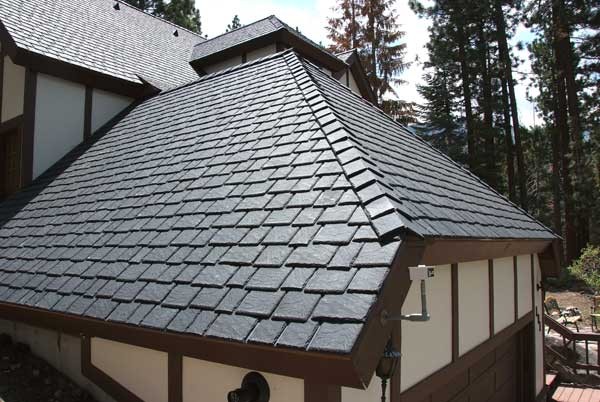
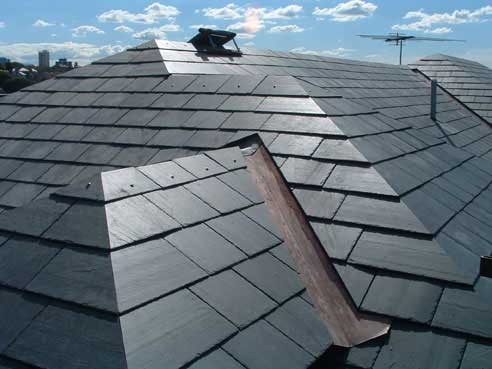
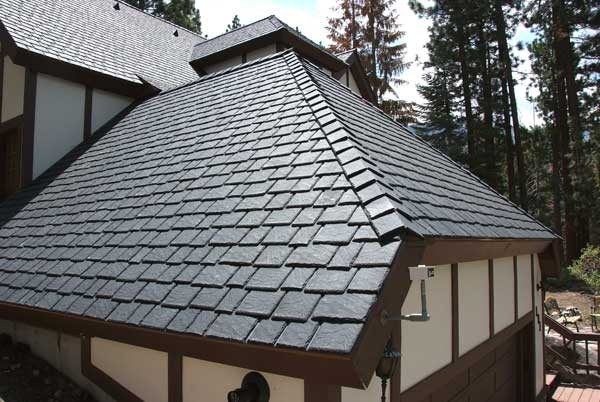
Achieving an antique roofing appearance in the 1920s also produced a degree of roofing services slate craftsmanship unrivalled in other eras, for old slate roofs implied no evident use of metal flashing. When slate replaced, or actually covered, metal for hips and ridges, it had to be cut to specific angles and applied in various ways to create mitered, Boston or fantail hips, and saddle or comb ridges. In this period, it was also less acceptable (even if wiser) to have valley metal showing with the result that valleys were closed with slate and sometimes for additional effect, rounded. If finishing hips, ridges and valleys in slate produced some of the most beautiful slate roofs in Canada, it also created the most expensive. The high cost of slate compared to new synthetic roofing materials ultimately reduced demand and even the luxury trade could not sustain economic volumes of production. The depression of the thirties effectively ended slate as a common roofing material. With texture as the desired effect, the decorative trends in 20th-century slate roofing ranged from the use of heavy slates about two inches thick, graduated coursing employing slates of diminishing lengths, thicknesses and widths from the eaves to the ridge, colour packages and roughly finished slates imitating stone. Small slates and a monogram or single-colour roof, particularly green, were favored in the first decade but thereafter larger and heavier slates with variegated colour effects became popular. The 1920s highlighted slate roofing craftsmanship not only through its more complicated graduated slopes, but also in its charming slate hips and valleys which, in special projects, replaced the almost universal copper and galvanized iron flashing’s of the previous century.

Renewal of the Graduated Slate

June 7th, 2011

It was not only effect but also respect for the inherent qualities of the materials of building that encouraged the renewal of the graduated slate roof in roof replacement. In a lecture on “the Art of Building,” M.H. Baillie Scott, a leader with Charles Voysey in the promotion of the artistic house, urged the study of materials as the proper beginning of architecture: “If only instead of ignoring the qualities of materials and forcing them into meaningless forms, we were to begin at the other end, what a new world of art would be disclosed to us.” Scott considered the most important quality of roofing materials was texture. “Nothing,” he remarked, “is so fatal to the beauty of a roof as tiles which are absolutely regular giving the effect of a surface ruled with absolutely rigid horizontal lines. You might as well cover your building with galvanized iron at once.” Scott’s lecture, which was published in Construction in April 1910, advocated the use of the roughest and thickest slates but criticized slates generally for their failure to yield “to nature’s inimitable colouring.” This conclusion betrayed his experience of English slate and his ignorance of the gamut of fading and variegated slates in America. Curiously, despite its discussion and publicity, nearly a decade passed before the graduated slate roof appeared in Canada. The regular notices of domestic work in Construction first mentioned graduated slating in 1917 in a description of a “Georgian” red brick residence designed for L.C. Webster in Westmount, Quebec, which it stated, was covered with “rough green slates laid in graduating courses.” By 1919 two Toronto homes featured in the same magazine indicated varying colours as well as sizes were being used. The roof of a grey brick residence of classical English influence at Lonsdale and Dunvegan Roads was slated with a mixture of greys, greens and browns including both the unfading and the weathered varieties.

Slates of random widths and rough edges were laid with a free graduation toward the ridge. A similar roof of unspecified colours was also used to cover a green shuttered, white stucco home in Cedarvale.

Attractiveness of Slate Roofs in the Beginning of the 20th century

June 6th, 2011

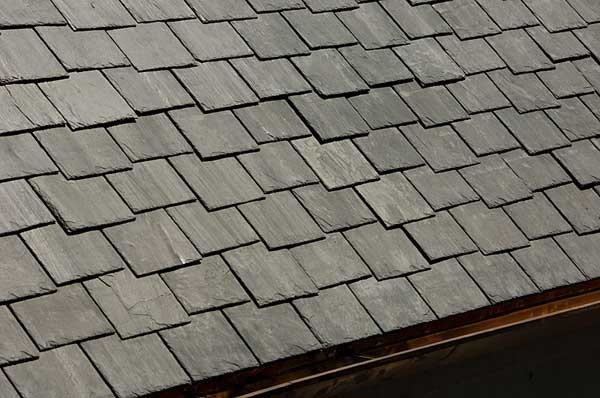
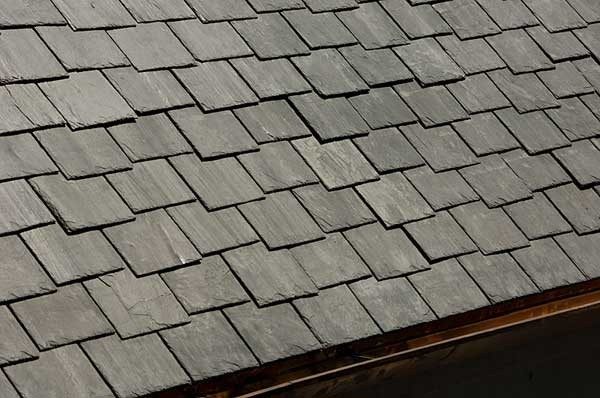
From 1908, the graduated slate roof received notice in the building periodicals as a way of beautifying slate roofs “marked off into distressingly regular squares or lozenges.” The idea was an Arts and Crafts one extolled in the American magazine, The Craftsman, and first brought to the attention of Canadians in an article on “Attractiveness in Slate Roofs” that appeared in The Contract Record. The graduated slate roof was actually a reversion to methods of roof installation in the days before sizes or thicknesses were standardized. After sufficient slate shingles were extracted from the quarry the slates were sorted according to length and thickness, then laid with the broader heavier slates close to the eaves and the smaller, lighter slates toward the ridge. The rough texture and uneven edges of the variously sized slates imparted a definite charm to the roof that was enhanced by the use of different colours of slate that often occurred naturally in the same quarry. As The Contract Record pointed out, a graduated slate roof could produce the effects of an old roof immediately: Earth and rock colours, combined with the rough surface and ruffed edges of the slates, make it possible to have a roof that from the very first has all the appearance of age and that harmonizes not only with the building but with all the surrounding landscape, because both colour and surface are those of the natural rock.

Various Slate Colours and Designs in History

June 5th, 2011

North American architects designing in the Queen Anne mode from the mid-1870s shared the English preference for one-colour red roofs. The shift in focus appeared in the pattern books as early as 1878. Modern Dwellings, based on a scribes of designs Henry Hudson Holly had published in Harper’s Magazine, noted, “Red for roofs seems to be growing much in favor.” It added that introduction of several colours was “objectionable, as it is apt to destroy the repose, and appear frivolous.” Unlike their English counterparts, architects in the United States and Canada had access to the red slates of the New York/Vermont slate belt as well as black, grey, variegated, fading and unfading green slates for a new roof. Because of its proven experience and its availability in a wide range of colour, slate was always more accepted than tile for roofing Queen Anne buildings on this side of the Atlantic. Many designs for the famous American Shingle Style, a Shavian (Norman Shaw) inspired mode named for its indigenous exterior cladding, also called for slate roofs but one colour was de rigueur.

By December 1884 the change in slating taste was receiving notice in Colour effects are not nearly so popular with present architectural styles as they were formerly … The tendency [now] seems to be to use a single colour of slate, or at most two shades of the same general colour, and to obtain the principal effect by judicious combination of patterns. Canadian slated buildings of Queen Anne Revival influence, the largest stylistic grouping with slate roofs recorded by CIHB, reflect the one-colour roofs typical of the mode. Colour verification of a selection of black and white inventory photos indicated the predominant use of black slate. This finding is consistent with the fact that during this period the Canadian slate roofing tiles industry, which produced blue-black slate, was at its height. In the 1889 Montreal residence commissioned by Senator George Drummond, President of the New Rockland Slate Company, the steep black slate roof with its many turrets and gables was combined with rock-faced red sandstone walls. As a rule, however, the black slate-roofed Queen Anne buildings of Canada were brick houses situated in Ontario. Slating typically capped a building of brick walls trimmed with stone and tiled or decoratively shingled gables.

The polychrome slate roof represented the antithesis of the subtle layering of materials and colours the Queen Anne mode was to convey. It, nevertheless, appeared on a Queen Anne-inspired Chatcauguay, residence in one of the most picturesque, if stylistically atypical, slate roofs of this study.

Red slate roofs emerged on Canadian Queen Anne Revival buildings of Richardsonian Romanesque influence. It is a moot point whether such buildings should be labelled Queen Anne or Richardsonian. Architect H.H. Richardson was in the forefront of the aesthetic movement in the United States and created the first Shavian manor in American materials. He increasingly drew inspiration from French forms and boldly employed stone in the development of a highly personal style identified by pyramidal massing, and arcaded quarry-faced masonry walls. The features of Richardson Romanesque became the decorative cliches for public building all over North America and in the domestic sphere were liberally mixed with the Queen Anne mode. Many of these hybrid residences were slated black or grey but red became a favorite of those built with red or buff sandstone.

Slate Roofing History – More on the Blog

June 4th, 2011

Variously cut slate to heighten roof decoration was strongly discouraged by the promoters of Queen Anne and just as strongly ignored by its mass interpreters. The pretty effect of tiles pointed to form a saw tooth line or rounded like fish scales was admitted by J.J. Stevenson, but he added “our architecture lately has trusted too much for its effect to such little prettiness … The glory of a plain tile roof,” he noted “is that its mass of quiet beautiful colour gives dignity to the worst and most fantastic architecture.” The noble bearing expected of a roof in this period was echoed by H.H. Holly’s admonition that “(Tiles) when worked into fancy forms lose their dignity.”

Nonetheless, fancy forms in slating persisted in Queen Anne architecture in Canada. Like Second Empire slate roofs, however, Queen Anne slate work was nearly always in one colour. Plain or common slating in the Romanesque Revival, Chateau and other eclectic modes.

With the institutional adoption of the Richardsonian mode in the late 1880s and 1890s, public building in Canada saw a gradual return to continuous replace roof slating which was the builder’s term for straight-cut slate work uninterrupted by diverse colours or shapes. Discreet bands of scalloped slating appeared on the New Rockland blue slate roof of Redpath Library at McGill University. The slated roofs of other Richardsonian-inspired buildings such as the provincial legislatures of Ontario and British Columbia, the 1899 Court House in St. John’s, Newfoundland, and the London Public Library 1894, displayed smooth surfaces of continuous or plain work. Taken collectively these buildings also suggest that from the 1890s the black slate roof was being replaced by a wider colour palette that included solid green, red and purple roofs. In the example of the London Public Library red slate again appeared with Scottish red sandstone.

Plain or common slating at its showiest was manifested in the Chateau style that had its sources in the 16th-century chateaux of the Loire Valley. Though the stately homes of the French nobility were distinguished by their ample roofs sheathed with gleaming surfaces of small slate, the Canadian adaptation for its railway hotels did not often use slating. When it was employed, however, as in architect Bruce Price’s hotel station at Place Viger in Montreal, thin, small straight-cut slates expressed the same fine smooth elegance of the French chateaux. At Craigdarroch Castle in Victoria, an aristocratic residence of mixed Romanesque and Scottish Baronial influences, lustrous planes of red slate highlighted the chateau roof and provided a vivid textural contrast with the rock-faced stonework of the facade. The return to symbols exploited by the Chateau style railway hotels was one of the themes of the Beaux-Arts movement which gained ground in Canadian cities around the turn of the century. Architects, tired of the dabbling in styles which had grown out of Queen Anne, returned to other historical
models. In their search for order and clarity, many increasingly went to classical sources. The Chicago World’s Fair of 1893 was an ode to monumental classical forms that epitomized the academic reaction. Beaux-Art classicism diminished the roof in the composition of public architecture and this process was completed by the concurrent development of the skyscraper. Symbolic, eclectic architecture in other modes, such as collegiate gothic for schools, would perpetuate slating in the public sector but it was domestic building that set new stylistic trends in slate roofing in the 20th century.

Single colour slate

June 3rd, 2011

Single colour slate with scaling in the Queen Anne Revival The Queen Anne Revival mode led the return to single colour slate work. Queen Anne style had a little to do with Queen Anne and much to do with many other countries and monarchs. The style as it evolved under English architect Richard Norman Shaw and others, showed great admiration for the forms of late 17th- and early 18th-century British building with its mix of classical and medieval features and its ornamental treatment of brick, tile and other materials used by a roofer. The characteristic motifs which came to define the style such as small-paned sash windows, rubbed (decoratively shaped) and cut brick-work, and tile or half-timbered gables were seen as typically English, but it also included shaped Flemish gables, Venetian windows and Japanese-inspired interiors. The point was to blend diverse elements in an original manner to create something comfortable, delicate and graceful. The practitioners of the Queen Anne style loved rich colour but they shunned the strident Gothic combinations in favour of harmonious tones. They usually expressed tones subtly by layering materials such as a red-brick ground storey with tile-hung walls, half-timbered gables and a slate or tile roof. Loud-patterned slate roofs would merely have destroyed the natural refined impression the style was intended to convey.

The Queen Anne architects’ attention to colour also produced definite ideas regarding suitable colours for roofs. Red, the colour of the tile which was the characteristic covering for English houses, was the preferred roof colour of the English originators of the mode. J J. Stevenson, one of the few theorists of the Queen Anne style, endorsed red tile because it was “better in colour than most slates.” In his two-volume work on House Architecture (1880), Stevenson discouraged the use of Welsh slates, most of which were a “bad” purple colour but recommended Westmorland green slates as “charming in colour, being a pale sea green, which goes well with red brick or against the sky. A decade later the colour of Welsh slates was still in disrepute when William Morris, the giant of the Arts and Crafts Movement, strongly criticized “Thin Welsh Blue Slates” as akin to corrugated iron and zinc.

Picturesque, polychromatic slate designs

June 2nd, 2011

Picturesque, polychromatic slate designs in Canadian roofing installation were most often identified with the Second Empire mode and yet variously cut slates of uniform colour were the norm for Canadian mansards. The predominant use of all black slating was a natural outcome of supply. The chapter on slate sources indicates that until 1900, 80 percent of the Canadian market was provided from the black slate belt of the Eastern Townships. Government House in Toronto (1868-70) roofed with slate from Quebec’s Melbourne, quarry, developed in the 1860s, was an example of a high-style Second Empire residence using continuous black slating. This manner of applying slate was in greater evidence in multiple housing, schools and religious institutions — buildings that had adopted the mansard idiom as a practical way of providing additional living space. Heavy concentrations of slating have been recorded on mansarded row housing throughout Montreal on such streets as Cherrier and St. Hubert. Maison Mere Villa Maria (1878), College du Vieux Montreal (1888), and other mansarded Roman Catholic convents and colleges across Canada again illustrated the widespread use of black slate roofing. The High Victorian principle of polychrome which characterized the slate roofs of so many Gothic Revival and Second Empire buildings in Canada endured from the late 1850s to the late 1880s. Anchored in English reinterpretations of the Gothic Revival and a return to continental and particularly Italian sources, the colorful slate patterns which emulated the geometric mosaics of medieval brick and marble were seen at their jagged Gothic best in the churches of Ontario. The colour banding of variously cut slate equally typical of High Victorian Gothic was continued in the Second Empire mode, where love of the curved form produced some of the most delightfully picturesque, polychrome slate designs in Canadian domestic architecture. Polychrome slating also crept into other styles, such as the 1886-87 renovations of the Neoclassic 1852-53 Brantford County Court House. Architectural taste, however, ultimately tired of the rich slate designs that were dubbed oil-cloth or calico patterns. The undercurrent of uniformly coloured slating that marked the diffused Second Empire mode grew stronger in the late 1870s and early 1880s.

More about slate: http://www.proroofing.ca/slate-roofing.html